Dimensioni e quota di mercato delle proteine delle fave
Panoramica di mercato
| Periodo di studio | 2021 - 2031 |
|---|---|
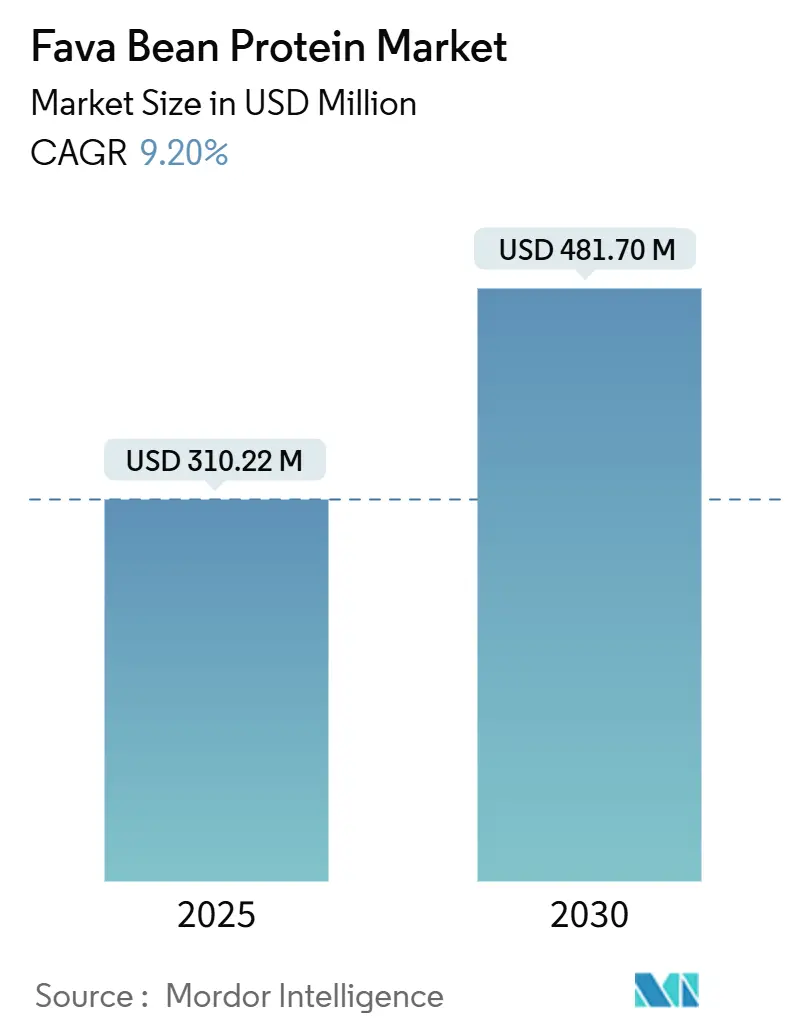
| Dimensione del mercato (2026) | USD 109.89 milioni |
| Dimensione del mercato (2030) | USD 168.68 milioni |
| Tasso di crescita (2026 - 2031) | 8.95% CAGR |
| Mercato in più rapida crescita | Asia Pacifico |
| Il mercato più grande | Nord America |
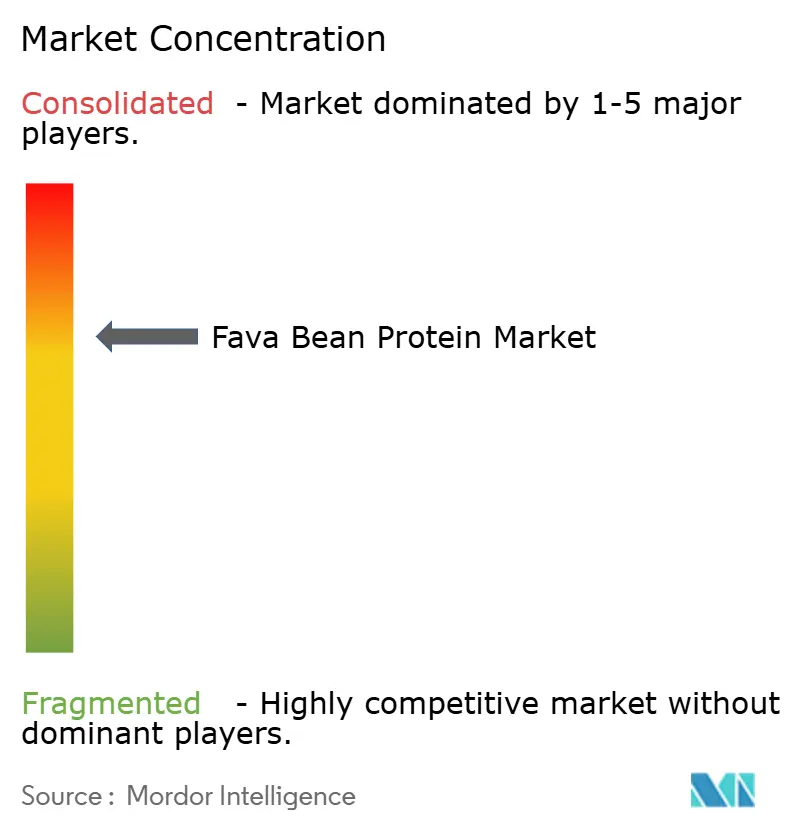
| Concentrazione del mercato | Medio |
Principali giocatori
*Disclaimer: i giocatori principali sono ordinati senza un ordine particolare Immagine © Mordor Intelligence. Il riutilizzo richiede l'attribuzione secondo la licenza CC BY 4.0. |
|
Analisi del mercato delle proteine delle fave di Mordor Intelligence
The fava bean protein market size was valued at USD 102.65 million in 2025 and estimated to grow from USD 109.89 million in 2026 to reach USD 168.68 million by 2031, at a CAGR of 8.95% during the forecast period (2026-2031). The Fava bean protein market is gaining attention as food formulators look beyond soy and dairy proteins and assess legume ingredients with lower allergen concerns. Fava beans can fix atmospheric nitrogen, which can reduce the need for synthetic fertilizer and support sourcing programs that place value on agricultural inputs and supply resilience. The market also benefits when buyers seek another option alongside pea protein rather than a direct replacement for it. In practice, this gives procurement teams a way to build supply flexibility without changing every formulation at once. It also allows technical teams to test fava performance in targeted recipes before committing to a wider portfolio change. Ingredient developers are focusing on functional performance, neutral taste, protein purity, and label simplicity when selecting fava-based ingredients.
Punti chiave del rapporto
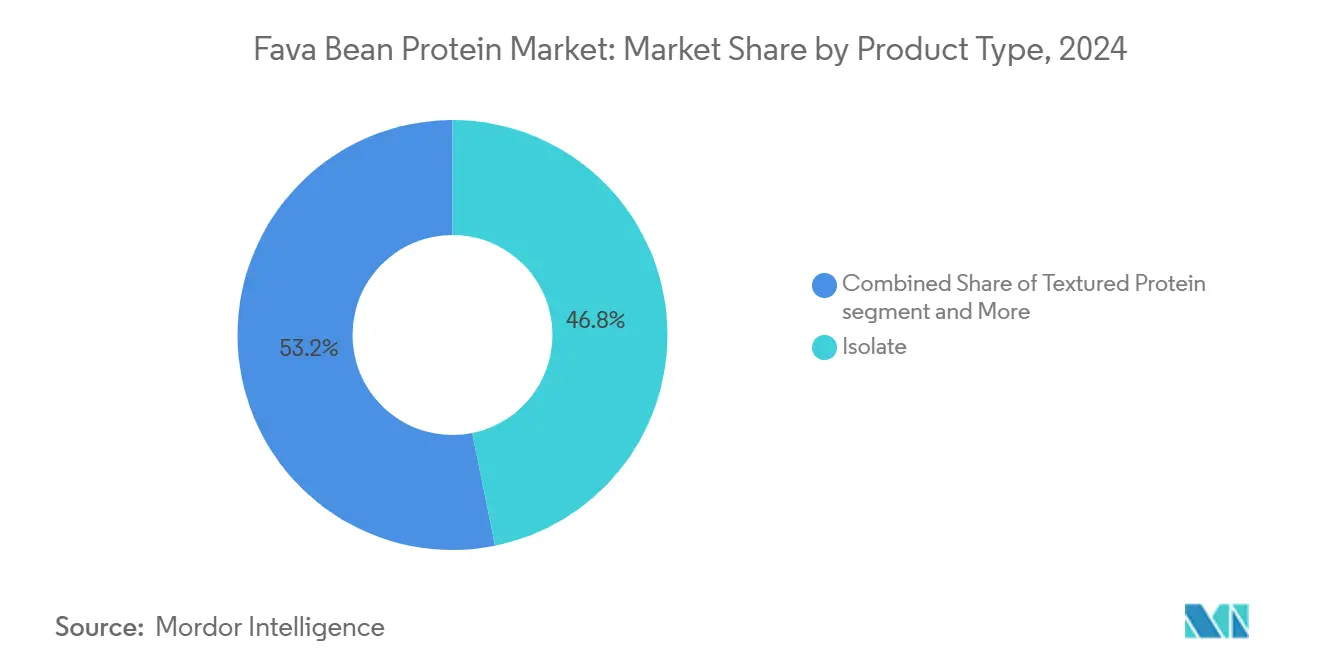
- By product type, isolates held 46.74% of the Fava bean protein market share in 2025, while textured protein is projected to grow at a 9.87% CAGR through 2031.
- By nature, conventional products held 81.57% of the Fava bean protein market share in 2025, while organic products are projected to grow at a 10.11% CAGR through 2031.
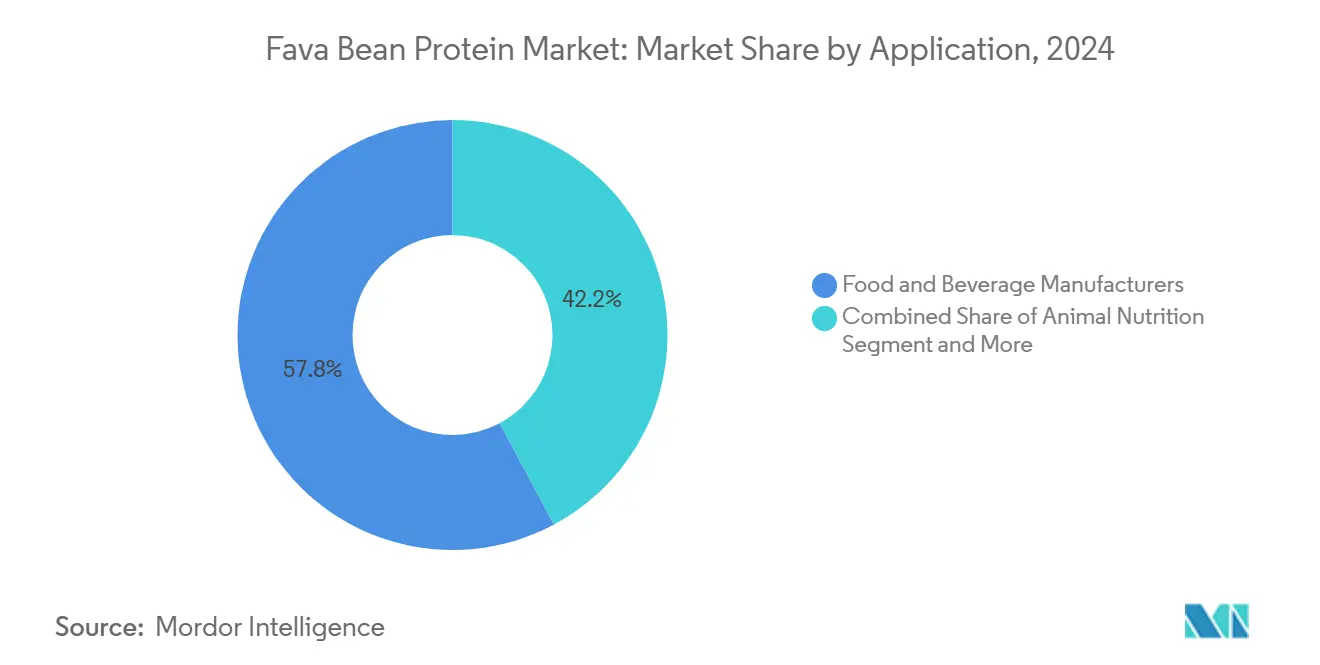
- By application, food and beverage accounted for 57.75% of the Fava bean protein market size in 2025 and is projected to expand at a 9.61% CAGR through 2031.
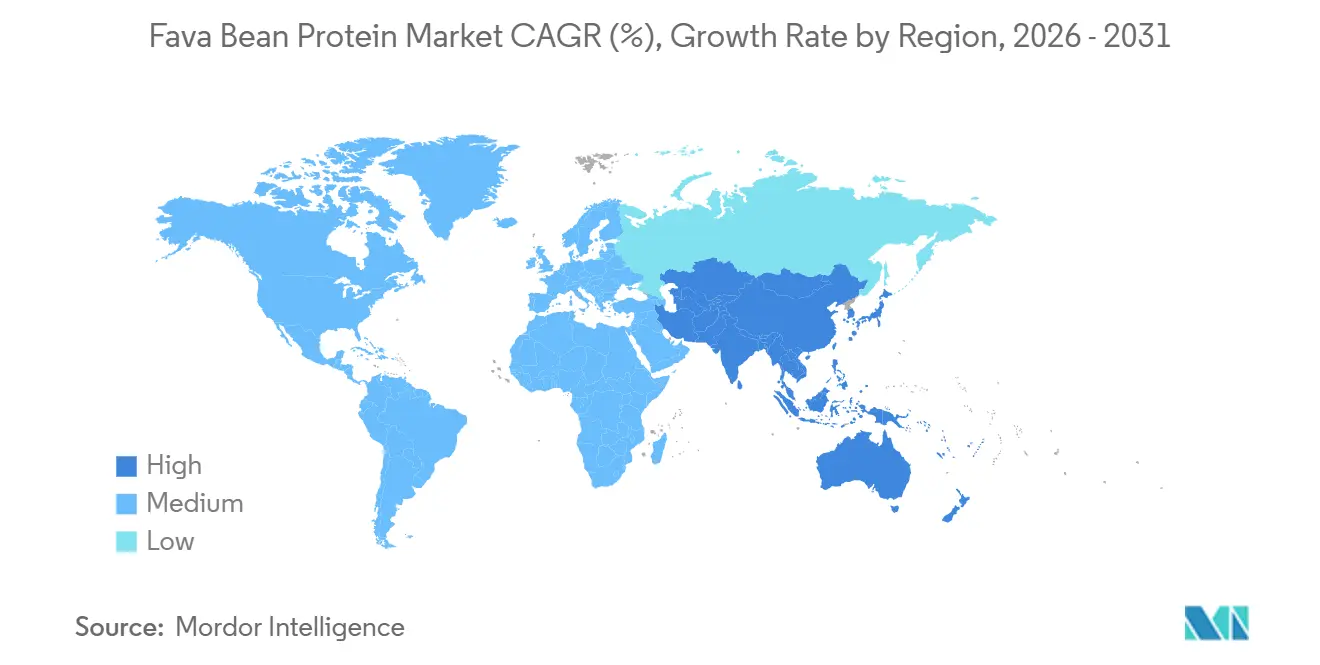
- Dal punto di vista geografico, nel 2025 il Nord America deteneva il 38.41% del mercato, mentre si prevede che la regione Asia-Pacifico crescerà a un tasso annuo composto del 9.74% fino al 2031.
Nota: le dimensioni del mercato e le cifre previste in questo rapporto sono generate utilizzando il framework di stima proprietario di Mordor Intelligence, aggiornato con i dati e le informazioni più recenti disponibili a gennaio 2026.
Tendenze e approfondimenti sul mercato globale delle proteine delle fave
Analisi dell'impatto dei conducenti
| Guidatore | % Impatto sulla previsione del CAGR | Rilevanza geografica | Cronologia dell'impatto |
|---|---|---|---|
| Increasing demand for allergen-friendly protein ingredients | + 2.0% | Global, strongest in North America and European Union | Medio termine (2–4 anni) |
| Rapid expansion of the plant-based food industry | + 2.3% | Global, core in North America, Europe, Asia-Pacific | A lungo termine (≥ 4 anni) |
| Advances in protein extraction and fractionation technologies | + 1.5% | North America, Europe, Asia-Pacific innovation hubs | A lungo termine (≥ 4 anni) |
| Rising demand for clean-label plant protein ingredients | + 1.6% | North America & European Union core, spill-over to Asia-Pacific | Medio termine (2–4 anni) |
| Growing adoption in high-protein and functional foods | + 1.2% | Global, acceleration in Asia-Pacific | A lungo termine (≥ 4 anni) |
| Favorable functional properties in food formulations | + 0.9% | Nord America, Europa, Asia-Pacifico | A breve termine (≤ 2 anni) |
| Fonte: Intelligenza di Mordor | |||
Increasing Demand for Allergen-Friendly Protein Ingredients
The Fava bean protein market is supported by demand for soy-free and dairy-free ingredient options. fave are not listed among the major allergens in the European Union food information regulation, which can make them useful in products designed around free-from positioning[1]Source: European Union, "Regulation (EU) No 1169/2011 of the European Parliament and of the Council of 25 October 2011 on the provision of food information to consumers, amending Regulations (EC) No 1924/2006 and (EC) No 1925/2006", eur-lex.europa.eu. This status matters because formulators have fewer protein choices when a product must avoid both soy and dairy. Breeding work that reduces vicine and convicine may extend the range of fava ingredients available to people who limit fava consumption because of G6PD deficiency. Burcon NutraScience launched FavaPro in August 2025 as a non-GMO fava protein isolate with more than 90% purity, showing how allergen-related positioning is being translated into a commercial ingredient.
Rapid Expansion of the Plant-Based Food Industry
The Fava bean protein market is linked to continued reformulation activity in plant-based foods. Food brands are assessing ingredients for functional performance as well as protein content. North American developers use fava protein in meat analogue applications, while European developers also use it to diversify protein supply. The European Commission’s Farm to Fork policy supports a food system with a reduced dependence on imported protein feedstocks, which aligns with interest in locally sourced pulse proteins[2]Source: European Union, "Regulation (EU) No 1169/2011 of the European Parliament and of the Council of 25 October 2011 on the provision of food information to consumers, amending Regulations (EC) No 1924/2006 and (EC) No 1925/2006", eur-lex.europa.eu. This combination of application demand and supply diversification can support longer qualification cycles and ingredient purchasing relationships across more than one region. It also gives suppliers a rationale to invest in local processing and customer trials even when demand in one application is still developing.
Advances in Protein Extraction and Fractionation Technologies
Extraction technology is expanding the functional options available in the Fava bean protein market. A 2025 study reported that multi-fraction alkaline-isoelectric extraction recovered side-stream proteins at purities of up to 89.6%. The study also found that one side-stream fraction had oil-holding capacity of 1.6 g/g, compared with 1.44 g/g for a conventional isolate. These properties are relevant to meat alternatives and dairy alternatives that need lipid retention and stable texture. Dry fractionation and other lower-water processing routes may change the economics of protein recovery, which will influence how closely fava products can compete with established pea protein supply. The change matters because recovery yield, energy use, and the ability to use several fractions from one raw material lot affect the cost of an ingredient before it reaches a food manufacturer.
Rising Demand for Clean-Label Plant Protein Ingredients
The fava bean protein market benefits from food manufacturers’ growing preference for clean-label ingredients and simplified processing methods. According to the CBI Ministry of Foreign Affairs, clean-label products are projected to account for over 70% of European product portfolios in 2025 and 2026, up from 52% in 2021[3]Fonte: CBI Ministero degli Affari Esteri, "Quali tendenze offrono opportunità", cbi.eu. Water-free and minimal-solvent fractionation can reduce the use of processing aids, supporting simpler ingredient narratives. In 2025, GoodMills Innovation introduced VITATEX Wheat-Fava Flakes SVP Pro, a co-texturized wheat and fava ingredient designed for GMO-free applications. Combining wheat and fava proteins can also improve amino acid complementarity, as wheat contributes methionine while fava beans provide lysine, helping manufacturers develop plant-based formulations with recognizable ingredients and suitable textures.
Analisi dell'impatto delle restrizioni
| moderazione | % Impatto sulla previsione del CAGR | Rilevanza geografica | Cronologia dell'impatto |
|---|---|---|---|
| Presence of off-flavors and beany taste | -1.2% | Global, most acute in beverage applications | A breve termine (≤ 2 anni) |
| Competition from well-established plant proteins | -1.5% | Nord America e Unione Europea | Medio termine (2–4 anni) |
| Cost-intensive protein extraction and ingredient processing requirements | -0.9% | Global, especially emerging Asia-Pacific markets | A lungo termine (≥ 4 anni) |
| Raw material supply volatility driven by regional cultivation and seasonal harvest patterns | -0.7% | European Union, South America, Asia-Pacific | Medio termine (2–4 anni) |
| Fonte: Intelligenza di Mordor | |||
Presence of Off-Flavors and Beany Taste
Off-flavors remain a practical limit for the Fava bean protein market, especially in beverages and other taste-sensitive products. Vicine, convicine, and lipoxygenase activity can contribute to hexanal and related volatile compounds that cause beany or bitter notes. Formulators may need deodorization, flavor masking, or lower inclusion levels, which can raise formulation cost or reduce the protein contribution. A 2025 study found that plasma-activated water changed the solubility and structural properties of fava bean protein isolate, indicating a possible route for modifying flavor-related processing conditions. Industrial-scale use remains early, so pea protein can retain an advantage in applications that require a neutral flavor profile. Until processing solutions become more widely available, beverage developers may limit fava inclusion levels or reserve the ingredient for formats where other flavors and ingredients can better manage the sensory profile.
Competition From Well-Established Plant Proteins
Established pea protein supply chains remain a major constraint on the Fava bean protein market. Processing capacity in Canada, France, and China has created established logistics, co-manufacturing relationships, and product performance records for pea ingredients. Fava protein therefore often enters product development as a complementary protein and a source-diversification option. This role limits short-term demand that would come from a full substitution of pea protein. It means suppliers need to show how fava improves a protein system through diversification, nutritional balance, or specific functional properties instead of presenting it as a universal substitute. It can also reduce the risk of a direct price and volume contest because buyers may qualify fava as an additional ingredient within a broader protein portfolio.
Analisi del segmento
By Product Type: Isolates Lead Current Value While Textured Protein Sets the Growth Pace
Isolates held 46.74% of the Fava bean protein market in 2025, reflecting their fit with high-purity applications. Beverages, dairy alternatives, sports nutrition, and baked goods use isolates when high protein content and consistent functionality are essential. Burcon’s FavaPro has more than 90% purity and is positioned for nutritional beverages, dairy alternatives, snacks, and bakery products. This product profile shows why isolates continue to anchor the higher-value end of ingredient demand, while their high purity makes it easier for developers to add protein without changing the rest of a recipe as much as a lower-purity ingredient could.
Textured protein is projected to grow at a 9.87% CAGR through 2031, the highest rate within product type. Demand for textured fava formats is supported by the need for structure, bite, and moisture retention in meat analogue products. These applications require the ingredient to perform after extrusion and during cooking, not only to deliver protein on a specification sheet. Suppliers that meet those requirements can address products where sensory experience determines whether consumers return to a plant-based option. GoodMills Innovation’s wheat-fava texturate was designed to deliver fiber and layer structures while maintaining integrity through thermal and mechanical processing.
Nota: le quote di tutti i segmenti individuali sono disponibili al momento dell'acquisto del report
Mercato delle proteine delle fave: quota di mercato per tipo di prodotto
| Isolare | 46.84% |
| Fonte: Intelligenza di Mordor | |
By Nature: Conventional Supply Retains Volume While Organic Products Grow Faster
Conventional products accounted for 81.57% of demand in 2025, reflecting the scale and cost structure of fava cultivation. This supply base gives processors access to raw materials suited to broad-volume ingredient programs. Conversion costs and certification timelines limit the area that can move quickly into certified-organic production. This is particularly relevant in regions where large-scale farming supports the existing raw material base. Conventional supply therefore remains important for ingredient buyers seeking volume and more predictable procurement conditions. It also provides the base from which processors can direct different fractions to food, feed, and other end uses according to their quality requirements.
Organic fava protein is projected to expand at a 10.11% CAGR through 2031. Premium sports nutrition and plant-based food brands use organic certification to distinguish ingredients in crowded product categories. Roquette lists organic pea-fava textured protein grades for applications including meat alternatives and dairy products, showing that industrial suppliers can incorporate organic fava sourcing into broader portfolios. European support for protein crops may encourage further organic conversion, although a faster rise in supply than demand could reduce organic price premiums during 2027 to 2029.
By Application: Food and Beverage Combines the Largest Share With the Fastest Growth
Food and beverage represented 57.75% of the Fava bean protein market size in 2025 and is forecast to grow at a 9.61% CAGR through 2031. It is both the largest application and the fastest-growing application in the supplied data. Meat and fish analogues require textured ingredients that retain structure and juiciness during thermal processing. Dairy alternatives, beverages, bakery products, snacks, and sports nutrition widen the application base beyond any single product category.
The Fava bean protein market has a further opportunity in beverage and yogurt-alternative formulations. The 2025 multi-fraction extraction study found that pH-soluble albumin fractions showed high solubility, which is relevant to these products. Animal nutrition uses lower-purity fractions that do not meet food-grade requirements and can improve raw material utilization for integrated processors. This role supports processing economics even though food and beverage remains the central source of value growth. Integrated producers can use each incoming crop more fully when food-grade isolation and lower-grade nutrition uses operate together. That can improve the value recovered from raw fava beans while reducing the volume of material left without a defined outlet.
Nota: le quote di tutti i segmenti individuali sono disponibili al momento dell'acquisto del report
Analisi geografica
North America held 38.41% of the Fava bean protein market in 2025. The region benefits from established plant-based food development, food technology pipelines, and demand for allergen-sensitive products. The United States has a clear setting for commercial development of new protein ingredients under its food safety framework. Burcon produces FavaPro at its Galesburg, Illinois facility, making the region both a demand center and a processing base for premium fava isolates. Canada contributes pulse crops and formulation capabilities, while Mexico and other markets in the region add end-use demand, including animal nutrition.
Europe is the second-largest regional position in the supplied analysis. Policy efforts to support domestic protein supply shape investment decisions across France, Germany, and the United Kingdom. The Farm to Fork strategy provides a policy setting that favors diversification away from imported soy-based protein supply. GoodMills Innovation’s 2025 launch of an EU-certified wheat-fava texturate reflects the combination of regional sourcing, clean-label demand, and application development in Europe. European novel food requirements can lengthen development timelines, but they can also create a barrier for suppliers that lack regulatory and technical resources. Larger suppliers and well-prepared specialists may therefore benefit when they can complete product development, documentation, and customer qualification in a coordinated way.
Asia-Pacific is projected to grow at a 9.74% CAGR through 2031, the fastest regional rate in the supplied data. The Fava bean protein market size in Asia-Pacific is shaped by rising protein demand, urbanization, and government nutrition programs in China and India. China offers familiarity with fava beans, while its food manufacturing sector is investing in higher-value protein processing. Australia strengthens the regional supply base through pulse crop exports and ingredient production for domestic and Southeast Asian customers. South America and the Middle East and Africa remain longer-term areas of interest, led by Brazil and Argentina in South America and by food security procurement priorities in South Africa and Saudi Arabia. These regions are not the present growth leaders in the supplied data, but they add to the range of markets where suppliers may pursue longer-horizon distribution and procurement relationships.
Panorama competitivo
The Fava bean protein market brings together diversified ingredient companies and specialist processors. Large suppliers can add fava to existing multi-protein portfolios and use established customer relationships, technical support, and processing assets. Specialists compete through extraction methods, European raw material sourcing, and targeted applications such as dairy alternatives and sports nutrition. Roquette’s fava isolate and organic pea-fava textured product range shows the portfolio approach used by larger ingredient suppliers. This mix of company types supports a moderately consolidated setting rather than a market led by a single supplier. Competitive advantage comes from combining raw material access, application knowledge, processing capability, and the ability to meet customer qualification requirements.
Product development is centered on purity, neutral flavor, functionality, and textural performance. Burcon’s 2025 launch of FavaPro added a more than 90% pure fava isolate for dairy alternatives, beverages, snacks, and baked goods. GoodMills Innovation’s 2025 wheat-fava product illustrates a different route, combining fava with wheat gluten to create a textured ingredient for meat-alternative formats. Roquette’s offering of fava isolate and pea-fava textured grades illustrates how suppliers can cover both isolate and texturized applications. These moves show that companies are using application-specific products rather than relying on a single fava ingredient format.
Competitive activity also depends on co-development and regional specialization, and suppliers that present fava as a supply-diversification ingredient can fit it into formulations that continue to use pea protein. Animal nutrition, aquaculture, and pet food can provide outlets for fractions that fall below food-grade specifications, while beverage applications remain an important open area because reliable deodorization could expand use in a category where flavor sensitivity is high. Food safety and regulatory compliance under European and U.S. requirements add development work and raise entry barriers for smaller suppliers. The competitive position of each supplier will depend on whether it can combine technical performance with a reliable source of fava raw materials, make ingredient quality consistent across harvests, and provide practical formulation support that converts product trials into recurring business.
Leader del settore delle proteine delle fave
-
Roquette Frères SA
-
Südzucker AG (Beneo)
-
Ingredion incorporata
-
Archer Daniels Midland Company
-
AGT Food and Ingredients Inc.
- *Disclaimer: i giocatori principali sono ordinati senza un ordine particolare
Recenti sviluppi del settore
- August 2025: Burcon NutraScience Corporation achieved first commercial production and launched FavaPro, a more than 90% pure fava protein isolate produced at its Galesburg, Illinois facility. The ingredient is non-GMO and hypoallergenic, with a neutral flavor profile for dairy alternatives, nutritional beverages, snacks, and baked goods.
- June 2025: Roquette expanded its NUTRALYS plant protein portfolio with NUTRALYS T Wheat 60 and NUTRALYS T PEA 700XC textured proteins. Its multi-species portfolio includes NUTRALYS Fava S900M fava bean protein isolate and organic pea-fava textured protein grades.
- March 2025: GoodMills Innovation launched VITATEX Wheat-Fava Flakes SVP Pro, a co-texturized ingredient produced through shared extrusion of wheat gluten and fava bean protein. It is designed for vegan pulled-meat, skewer, and sliced-meat applications and uses EU-certified raw materials.
Ambito del rapporto sul mercato globale delle proteine delle fave
Fava bean protein is a plant-based protein ingredient extracted from fava beans, also known as broad beans (Vicia faba). It is commonly produced in concentrated or isolated forms and used in food and beverage applications to increase protein content, improve texture, and support the development of plant-based products. The fava bean protein market is segmented by product type, nature, application and geography. Based on product type, the market is segmented into concentrate, isolate and textured protein. Based on nature, the market is segmented into organic and conventional. Based on application, the market is segmented into food and beverage, animal nutrition and other applications. By geography, the market is segmented into North America, Europe, Asia-Pacific, South America, and Middle-East and Africa. For each segment, the market sizing and forecasting have been done in value terms (USD million).
| Isolare |
| Concentrarsi |
| Proteine testurizzate |
| Organic |
| Convenzionale |
| Cibo e Bevande | Analoghi di carne e pesce |
| Alternative ai latticini | |
| Panetteria e snack | |
| Sport e nutrizione clinica | |
| Bevande | |
| Nutrizione animale | |
| Altre applicazioni |
| Nord America | Stati Uniti |
| Canada | |
| Messico | |
| Resto del Nord America | |
| Europa | Germania |
| Regno Unito | |
| Italia | |
| Francia | |
| Spagna | |
| Resto d'Europa | |
| Asia-Pacifico | Cina |
| India | |
| Giappone | |
| Australia | |
| Resto dell'Asia-Pacifico | |
| Sud America | Brasile |
| Argentina | |
| Resto del Sud America | |
| Medio Oriente & Africa | Sud Africa |
| Arabia Saudita | |
| Resto del Medio Oriente e dell'Africa |
| Per tipo di prodotto | Isolare | |
| Concentrarsi | ||
| Proteine testurizzate | ||
| Dalla natura | Organic | |
| Convenzionale | ||
| Per Applicazione | Cibo e Bevande | Analoghi di carne e pesce |
| Alternative ai latticini | ||
| Panetteria e snack | ||
| Sport e nutrizione clinica | ||
| Bevande | ||
| Nutrizione animale | ||
| Altre applicazioni | ||
| Per geografia | Nord America | Stati Uniti |
| Canada | ||
| Messico | ||
| Resto del Nord America | ||
| Europa | Germania | |
| Regno Unito | ||
| Italia | ||
| Francia | ||
| Spagna | ||
| Resto d'Europa | ||
| Asia-Pacifico | Cina | |
| India | ||
| Giappone | ||
| Australia | ||
| Resto dell'Asia-Pacifico | ||
| Sud America | Brasile | |
| Argentina | ||
| Resto del Sud America | ||
| Medio Oriente & Africa | Sud Africa | |
| Arabia Saudita | ||
| Resto del Medio Oriente e dell'Africa | ||
Domande chiave a cui si risponde nel rapporto
What is driving demand for fava bean protein?
Demand is supported by interest in soy-free and dairy-free ingredients, cleaner labels, plant-based food reformulation, and supply diversification. The Fava bean protein market also benefits when developers use it alongside established proteins rather than asking one ingredient to perform every function.
How large is the fava bean protein sector?
The Fava bean protein market is projected to rise from USD 109.89 million in 2026 to USD 168.68 million by 2031, at an 8.95% CAGR. The forecast reflects demand across food and beverage, nutrition, and other ingredient applications.
Which fava bean protein product type is growing the fastest?
Textured protein is projected to grow at a 9.87% CAGR through 2031 because meat analogues need structure, bite, and moisture retention. This makes texture performance an important area of product development in the Fava bean protein market.
Which application leads demand for fava bean protein?
Food and beverage led with 57.75% of demand in 2025 and is projected to grow at a 9.61% CAGR through 2031. Meat and fish analogues, dairy alternatives, beverages, bakery products, and nutrition products broaden this application base.
Which region leads fava bean protein demand?
North America held 38.41% in 2025, while Asia-Pacific is projected to record the fastest regional growth at a 9.74% CAGR through 2031. The Fava bean protein market is therefore supported by both an established demand center and a faster-growing regional opportunity.